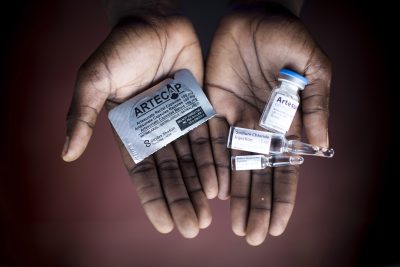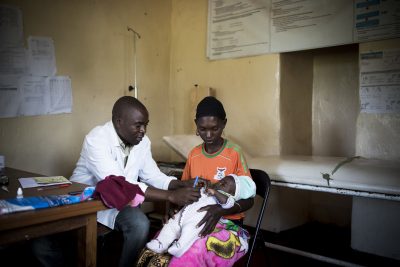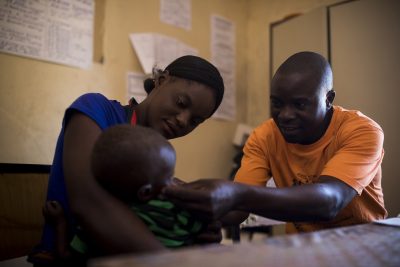


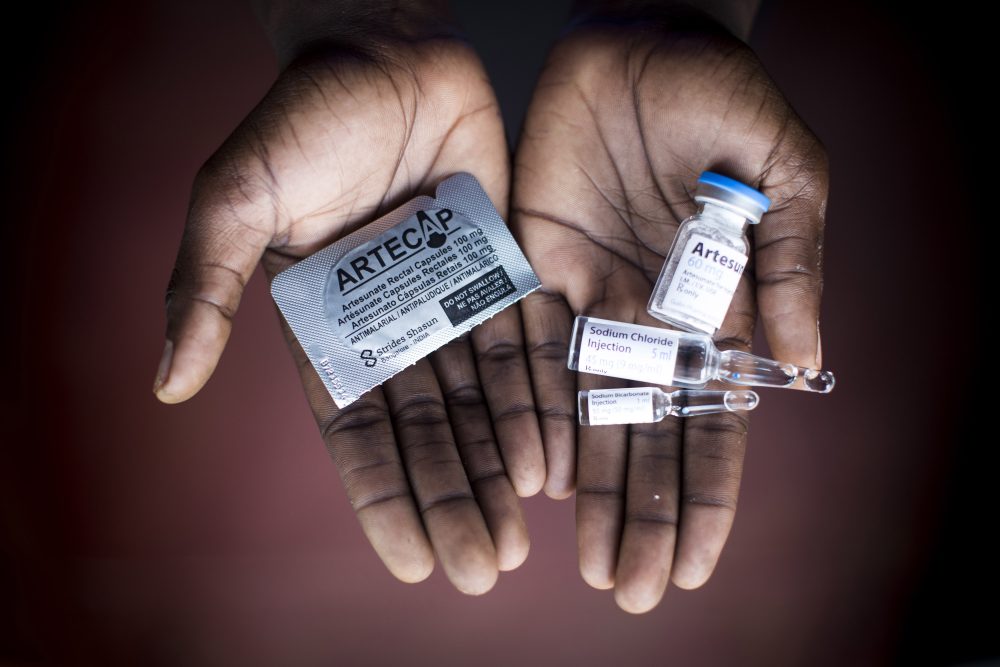
International development organisation, Transaid, has launched new guidelines, commissioned by Medicines for Malaria Venture (MMV), for pre-referral rectal artesunate (RAS) implementation, an intervention for severe malaria proven to substantially reduce the risk of death and disability among young children.
The guidelines provide practical tips on key aspects of RAS implementation at community level, including selecting sites, training Community Health Workers and front-line health workers based in health facilities in severe malaria case management, monitoring and evaluating RAS implementation and planning and budgeting for a RAS intervention. Formatting and design of the guidelines was supported by Transaid corporate partner, Brigade Electronics.
In March, the guidelines were launched at a webinar to a global audience comprising staff of health ministries and national malaria programmes, researchers and development practitioners.
Exemplifying Transaid’s ability to deliver at scale, initial implementation of the guidelines involved a member of the Zambia MAMaZ Against Malaria team traveling to Nigeria to train trainers from five states on the approach as part of the RAS implementation research study.
Hans Rietveld, Director of Access and Product Management at MMV, says: “The RAS implementation experience from Zambia has been a shining light for other countries. It shows that strengthening referral pathways, training community healthcare workers and sensitising the communities are key interventions which help improve the continuum of care for severe malaria patients, and save lives.
“This pioneering work, initiated by MMV in collaboration with Transaid and other partners, has served as a pathfinder for other national malaria programmes. There are now about 20 countries deploying RAS as a pre-referral intervention, and more to follow.”
RAS has been included in the World Health Organisation (WHO) Malaria Guidelines since 2015 as an effective pre-referral treatment for severe malaria. Following the release of the 2023 WHO field guide, countries planning to adopt RAS requested additional practical guidance on the design and implementation for community-based intervention in rural settings.
Caroline Barber, Chief Executive of Transaid, says: “One of the projects I’m most proud of at Transaid is the impact we’ve had in reducing the severe malaria case fatality rate in remote communities in Zambia.
“The guidelines we’ve now developed combine everything we’ve learned about the importance of community engagement, a functioning drug supply chain, implementation of emergency transport and increased access to key medicines to ensure more countries with a high malaria burden can save lives.”
Transaid’s MAMaZ Against Malaria programme was launched in Zambia in 2017, in collaboration with MMV, and by 2021 it had been rolled out to 10 districts. Community RAS was subsequently scaled up to additional districts by the Ministry of Health. The project was recognised in a WHO report in 2019 as “feasible, safe and effective in hard-to-reach communities”.
For more information and to find out how you can support the organisation visit www.transaid.org.
ends
Note to Editor:
About Transaid
Transaid transforms lives through safe, available, and sustainable transport. Founded by Save the Children, The Chartered Institute of Logistics and Transport (CILT), and its Patron, HRH The Princess Royal, the international development organisation works with communities, partners, and governments to solve transport challenges throughout sub-Saharan Africa.
Transaid works in two core areas, road safety and access to health, to solve two of the biggest transport challenges in sub-Saharan Africa. Transaid’s road safety work focuses on influencing safe driver behaviour with long term programmes in Ghana, Tanzania, Uganda and Zambia, responding to local needs for improved training for drivers and riders of trucks, buses, motorcycles and forklift trucks. On the access to health side, Transaid is working with local partners and communities to strengthen access to health services, primarily in rural areas. They are also working to strengthen health supply chains in collaboration with local partners and governments.
Transaid enjoys strong backing from the transport and logistics industry and the active involvement of its patron, HRH The Princess Royal.
For further press information:
Maddy Matheson at Transaid: +44 (0)20 7387 8136 / maddy@transaid.org
Natalie Ganshert or James Keeler at Garnett Keeler PR: +44 (0)20 8647 4467, or by email to natalie.ganshert@garnettkeeler.com / james.keeler@garnettkeeler.com
TRAN/457/25